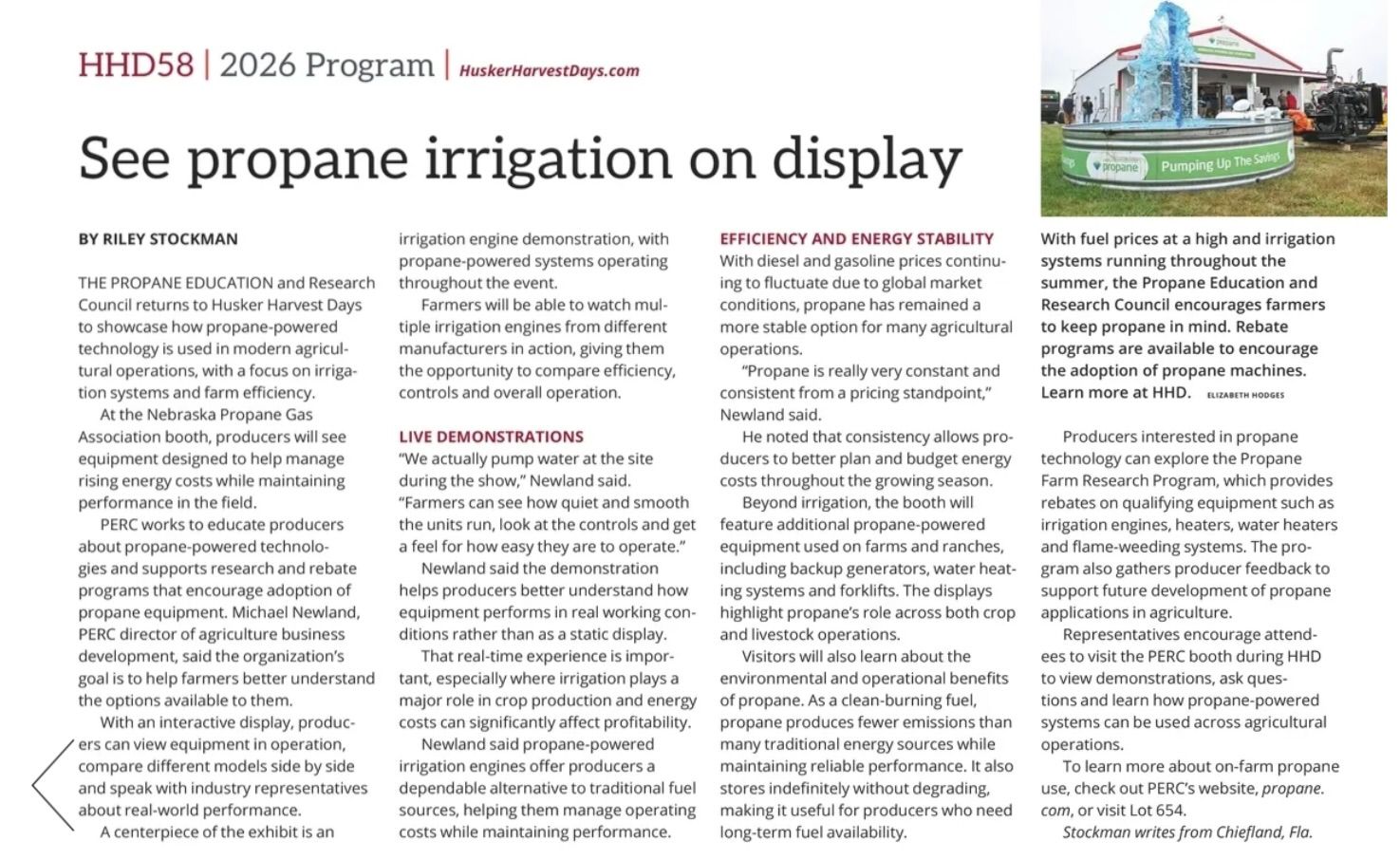
Propane efficiency on display

By Riley Stockman


The Propane Education and Research Council (PERC) will return to Husker Harvest Days to showcase how propane-powered technology is being used in modern agricultural operations, with a focus on irrigation systems and farm efficiency.

At the Nebraska Propane Gas Association booth, producers will see equipment designed to help manage rising energy costs while maintaining performance in the field.

PERC works to educate producers about propane-powered technologies and supports research and rebate programs that encourage adoption of propane equipment. Michael Newland, PERC director of agriculture business development, said the organization’s goal is to help farmers better understand the options available to them.

With an interactive display, producers can view equipment in operation, compare different models side by side and speak with industry representatives about real-world performance.


Live demonstrations


A centerpiece of the exhibit will be a live irrigation engine demonstration, with propane-powered systems operating throughout the event. Farmers will be able to watch multiple irrigation engines from different manufacturers in action, giving them the opportunity to compare efficiency, controls and overall operation.

“We actually pump water at the site during the show,” Newland said. “Farmers can see how quiet and smooth the units run, look at the controls and get a feel for how easy they are to operate.”Newland said the demonstration helps producers better understand how equipment performs in real working conditions rather than as a static display.

That real-time experience is important, especially where irrigation plays a major role in crop production and energy costs can significantly affect profitability.

Newland said propane-powered irrigation engines offer producers a dependable alternative to traditional fuel sources, helping them manage operating costs while maintaining performance.


Efficiency, savings and energy stability


With diesel and gasoline prices continuing to fluctuate due to global market conditions, propane has remained a more stable option for many agricultural operations.

“Propane is really very constant and consistent from a pricing standpoint,” Newland said.

Newland said that consistency allows producers to better plan and budget energy costs throughout the growing season.

Beyond irrigation, the booth will feature additional propane-powered equipment used on farms and ranches, including backup generators, water heating systems and forklifts. The displays highlight propane’s role across both crop and livestock operations.

Visitors will also learn about the environmental and operational benefits of propane. As a clean-burning fuel, propane produces fewer emissions than many traditional energy sources while maintaining reliable performance. It also stores indefinitely without degrading, making it useful for producers who need long-term fuel availability.

Producers interested in propane technology can explore the Propane Farm Research Program, which provides rebates on qualifying equipment such as irrigation engines, heaters, water heaters and flame-weeding systems. The program also gathers producer feedback to support future development of propane applications in agriculture.

Representatives encourage attendees to visit the PERC booth during HHD to view demonstrations, ask questions and learn how propane-powered systems can be used across agricultural operations. 

To learn more about on-farm propane use, check out PERC’s website or visit Lot 654 at the HHD showgrounds.

Stockman writes from Chiefland, Fla.


Growing Leaders Through FFA: How the Organization Shapes Lives

By Riley Stockman


Members of the National FFA Organization across Florida celebrated National FFA Week in February highlighting how the organization prepares students for leadership and career success in agriculture.

The weeklong event showcases the impact FFA has on students nationwide through hands-on experiences, leadership development events and career preparation opportunities.

According to the organization, FFA helps students build skills in public speaking, time management and responsibility while exploring careers in agriculture. Less than 2 percent of members earn the American FFA Degree, the organization’s highest honor.

Florida FFA state officer Ryleigh Locke is one example of how the program shapes students into leaders.

“FFA offers quite a bit of career and leadership development events. Public speaking, responsibility, time management, all those things help anyone be successful in life.”

Locke said her involvement in FFA began after participating in 4 H and being influenced by her father who spent 19 years as an agriculture educator.

“It was an easy transition for me. I wanted to be able to compete in the competitive events FFA had to offer.”

One of her most memorable experiences came after years of competing in Parliamentary Procedure contests.

“That was my favorite FFA career memory.”

Locke also expanded her agricultural knowledge internationally through the International Leadership Seminar for State Officers where she traveled to Spain and learned about agriculture abroad.

Through her supervised agricultural experience Locke has built a herd of 43 registered Angus cattle while continuing to work on her family’s operation.

As she works toward earning her American FFA Degree Locke said the recognition reflects years of hard work and commitment.

“It’s finally seeing the work pay off.”

Locke encourages students who may be unsure about joining to give the organization a chance.

“There is genuinely a spot for everyone in FFA.”